> For the complete documentation index, see [llms.txt](https://docs.ingestlabs.com/llms.txt). Markdown versions of documentation pages are available by appending `.md` to page URLs; this page is available as [Markdown](https://docs.ingestlabs.com/media-data-platform/dashboard/analytics-dashboard/event-flow.md).
# Event Flow
## Introduction
The **Event Flow dashboard** helps you understand how events occur over time and how frequently each event is triggered in your application.
## Dashboard – Overview Widget
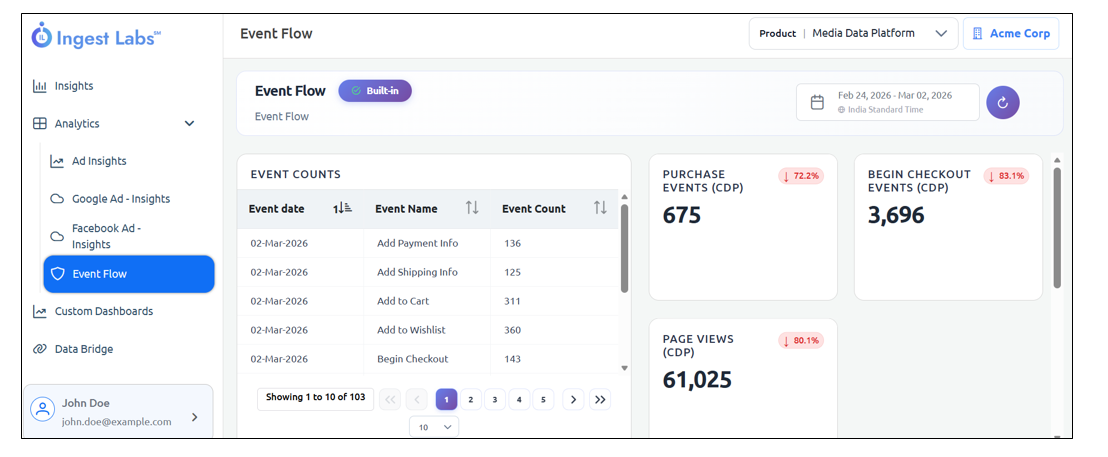
**Event Counts**
The **Event Counts** widget shows the total number of times each event occurred during the selected date range.
Event Date: Shows the **date on which the event occurred**.
Event Name: Shows the **name of the event** that was recorded.
Event Count: Shows the **total number of times the event occurred** on the selected date range.
The text Showing **1 to 10 of 103** indicates the range of records currently displayed and the total number of available records.
Click this drop-down to choose the number of records or values displayed in the widget.
The Previous and Next icons allow users to move to the previous or next page.
The First and Last icons allow users to jump to the first or last page of the results.
When you hover over, the following options are available:
**Export to CSV** – Downloads the widget data in CSV format.
**Refresh widget** – Refreshes the widget to load the latest data.
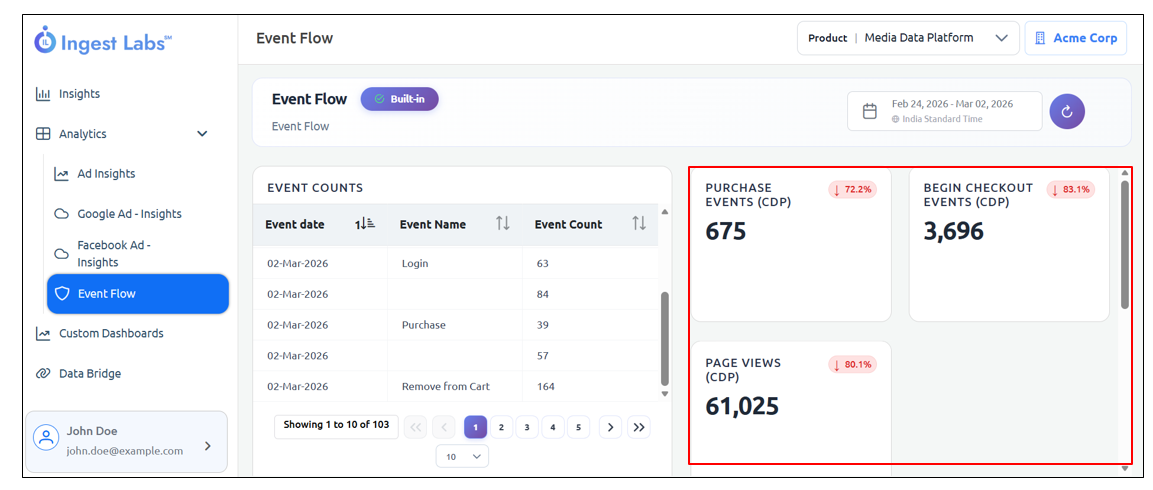
All widgets display data for the selected time period.
**Purchase Events:** Shows the total number of purchase events captured during the selected time period.
Begin Checkout: Shows the total number of begin checkout events during the selected time period.
Page Views (CDP): Shows the total number of page view events captured by the CDP during the selected time period.
When you hover over a widget, the following option is displayed:
**Refresh icon** – Refreshes only the selected widget and loads the latest data.
A **red downward arrow with a percentage** indicates that the value has **decreased** compared to the previous date range.
A **green upward arrow** indicates that the value has **increased** compared to the previous date range.
**Purchase Events**
Event Date: Shows the **date on which the purchase event occurred**.
Transaction ID: Shows the **unique identifier assigned to each purchase transaction**.
Event Count: Shows the **total number of purchase events** recorded for the selected time period.
The text Showing 21 **to 30 of 1430** indicates the range of records currently displayed and the total number of available records.
The page numbers allow users to directly navigate to a specific page.
The Previous and Next icons allow users to move to the previous or next page.
The First and Last icons allow users to jump to the first or last page of the results.
When you hover over a widget, the following option are displayed:
**Export to CSV** – Downloads the widget data in CSV format.
**Refresh widget** – Refreshes the widget to load the latest data.
## Date and Time Range
Use the Date and Time Range filter to select the period for which the widget data is displayed.
Note: By default, the Dashboard is set to display the data for the last 7 days.
Displays the currently selected start and end dates. At the moment, the dashboard is set to display data for the last seven days.
Click the drop-down to select a predefined date range, such as Today, Yesterday, Last 7 Days, This Month, or Previous Month. By default, *Last 7 Days* is selected.
You can use the slider to select the time range, and the selected time is displayed next to it.
Select the start and end dates directly from the calendar.
Use the left and right arrows to move between months.
Click ***Apply*** to apply the selected date and time range.
Click ***Cancel*** to discard your changes and close the filter.
{% embed url="" %}
---
# Agent Instructions
This documentation is published with GitBook. GitBook is the documentation platform designed so that both humans and AI agents can read, navigate, and reason over technical content effectively. Learn more at gitbook.com.
## Querying This Documentation
If you need additional information that is not directly available in this page, you can query the documentation by asking a question.
Perform an HTTP GET request on the following URL with the `ask` and `goal` query parameters:
```
GET https://docs.ingestlabs.com/media-data-platform/dashboard/analytics-dashboard/event-flow.md?ask=&goal=
```
`ask` is the immediate question: it should be specific, self-contained, and written in natural language.
`goal` is what the user is ultimately trying to achieve, the reason they need the answer. Sharing it helps GitBook give you a better, more relevant answer. A goal is most helpful when it describes the outcome the user wants rather than restating the question. For example, with `ask=how do I create an API token`, a goal like `automate deployments from our CI pipeline` lets GitBook tailor the answer to that use case.
The response will contain a direct answer to the question and relevant excerpts and sources from the documentation.
Use this mechanism when the answer is not explicitly present in the current page, you need clarification or additional context, or you want to retrieve related documentation sections.